AI and democracy: mapping the landscape
To understand AI's potential impact on democracy, Power for Democracies has built a map of AI-derived threats to democracy, the strategies proposed to mitigate them, and the opportunities to leverage AI for democratic benefit.
AI has been reshaping how information spreads, how governments operate, and how citizens participate. Deciding where to direct limited resources to protect democracy from these rapid developments has been far from straightforward. Part of the difficulty is that these threats are not equally easy to see. Deepfakes and disinformation are visible to anyone scrolling a feed, and they arrive with two decades of communication research behind them. Others – such as the saturation of administrative channels with AI-generated submissions, dependency on a handful of infrastructure providers, or the slow erosion of citizens' leverage over institutions – are invisible to the people affected and new as objects of study, with no adjoining field to draw on.
While various research communities have been working in parallel, producing valuable but fragmented analyses, no single resource exists that brings together these findings in a structured, investigable form, and there is little prioritisation between democratic threats and their respective counter-strategies. The evidence base is fragmented enough that mapping and prioritisation are themselves high-leverage philanthropic work.
The AI-democracy landscape tool
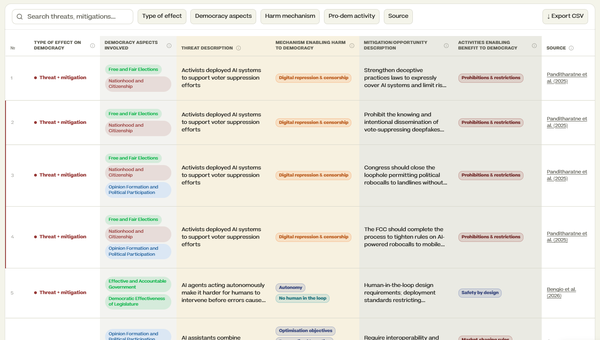
This interactive table allows you to drill down into threats, mitigations, and opportunities.
Mapping threats, mitigations and opportunities
Bringing together a wide range of sources makes it possible to see which aspects of democracy AI affects, and how the literature connects problems to proposed responses.
What we did
Given how fast AI is developing, we began filling these gaps as a priority. Our team reviewed a wide body of existing literature and selected 10 sources that systematically map AI's effects on democracy.
The selected literature spans multiple levels of abstraction, disciplinary lenses, and democratic contexts – from the Carnegie Endowment for International Peace's broad survey of AI and democracy to the Brennan Center for Justice's focus on US electoral integrity, to the global perspective of the 2026 International AI Safety Report.
We extracted and standardised entries from these sources into a unified, publicly available database containing:
- 161 documented AI threats to democracy
- 117 pro-democracy strategies for addressing AI threats to democracy
- 43 independent opportunities for strengthening democratic resilience
Each entry is coded onto three separate systems that can be combined for analyses.
The first records which aspects of democracy are affected, using a framework adapted from International IDEA and organised into four pillars: (1) citizenship, law and rights; (2) representative and accountable government; (3) civil society and popular participation; (4) transnational dynamics.
The second records the harm mechanism, delivering a more detailed view of the processes that induce the harm to democracy. We built this system based on the processes described in our sources and then ordered it by causal depth: from the conditions that shape how AI systems are built and released, through the properties and capabilities of the systems themselves and how they are used, to their cumulative effects on individuals and society as a whole. We distinguished 58 distinct mechanisms based on the sources for this system.
The third records the pro-democracy activities the sources propose, ranging from AI literacy and legal accountability frameworks through to cyber defence and responsible development practices. The system contains 10 clusters and 23 distinct activities.
We created a separate code system for harm mechanisms because the same democratic harm is reached by very different routes. Electoral integrity, for instance, is put at risk according to our sources by fabricated political content, biased AI use inside election administration, and cyberattacks on election infrastructure. These three problems have little in common in terms of who could address them or how. Conversely, a single mechanism can often threaten several aspects of democracy at once, so countering it can have protective effects across all of them.
What the map reveals (initial findings)
Bringing these sources together gives us an overview of the research in the AI and democracy field and allows patterns to be identified more easily. Here are some of the things we have noticed:
Attention concentrates on the information environment. The largest group of documented threats concerns deepfakes, disinformation, and AI-enabled persuasion at scale. This is also where proposed responses are most concrete: disclosure requirements, labelling laws, detection and provenance tooling.
Structural harms are described but rarely answered.
Threats that work slowly and diffusely, such as opacity in AI-assisted government decision-making, dependency on a handful of providers, or the gradual weakening of the citizenry’s leverage over institutions, are well represented in our sources. What is missing is the response.
Society-level and individual-level harms are the least likely of any category to come with a proposed mitigation, and the responses that are proposed tend to be general governance and evidence-building measures rather than interventions targeted directly at the mechanisms themselves. This is unsurprising: these broader dynamics are the downstream effects of more specific mechanisms that precede them and offer little to act on directly. Disentangling the causal chains behind them is how we identify the pro-democracy activities that could be brought to bear.
Effects on individuals are barely covered. Comparatively few of the entries documenting a threat mention how sustained interaction with AI reshapes individual thinking and behaviour (belief reinforcement, cognitive deskilling, emotional dependence on AI systems, erosion of trust). This may be due to our source selection. But individuals are integral to democratic discourse and decision-making, AI offers novel ways of structurally influencing how individuals think and decide, and those structural effects can be assumed to accumulate and contribute to the society-level dynamics discussed above. We therefore expect effects on individuals to receive more attention in future research.
Global transfer is an open question. The effects of AI on democracy are global, but the discourse and responses are largely concentrated in limited geographical regions such as the United States and the EU. Almost nowhere in the literature we explored was there serious engagement with how responses developed in one democratic context might apply in another, or with the experience of non-Western countries. This is partly a limitation of our own selection, which we intend to widen.
What comes next
In the next step, we want to use the database with the new codings. We will independently develop prioritisation criteria to assess harm mechanisms and pro-democracy activities, and then use the database in addition to expert interviews and desk research to identify effective ways of countering negative AI influences and organisations that are adopting these approaches. Extending and updating the database as we go would make it even more useful both for us and for other interested parties using it as a resource.
We are sharing the map and our methodology openly. If you are a researcher, funder, or practitioner working in this space and would like to engage with or build on this work, please get in touch.